

What We Mean by 'Conservative'
We want to build a big tent.


A friend of ours, a lifelong Democrat, lost her job last year for posting a Substack note that questioned whether biological males should compete in women’s sports. She wasn’t loud about it. She didn’t tag anyone. She wrote two paragraphs and went back to her actual job, which had nothing to do with sports or politics. Within a week her employer received complaints. Within a month she was out. She is now, by the standards of the people who pushed her out, a conservative. She has not changed most of her political positions. She still still sees blue on most issues, but just declined to repeat a sentence she did not believe.
This is the country we live in now. We’re telling this story because it captures the problem we want to address in the psychedelic space. Words like “conservative,” “liberal,” “safe,” and “inclusive” have become so loaded that many people no longer know whether they are welcome in conversations that should, by their nature, be open, curious, and humane. This post is our attempt to explain what we mean by “conservative,” why that temperament matters, and why we believe psychedelics need more pluralism, not less.
When we say conservative in this Substack, we are not talking about Republicans. We are not talking about Donald Trump or Ron DeSantis or the Heritage Foundation. We are not talking about anyone’s voter registration card. We are talking about small-c conservative, a disposition rather than a party, and one that until about ten minutes ago in historical terms was simply called being a normal American adult.
Small-c conservative means:
Personal responsibility, including for outcomes you did not choose
Freedom of speech, religion, and association
A skeptical eye toward the nanny state and toward anyone, in government or out of it, who wants to manage your life for your own good
An attitude of live and let live with neighbors who think differently
A healthy understanding that children and adults are different, and parents have a singular role in raising children
Caution about discarding traditions before you understand why they exist, and equal caution about adopting new arrangements before you understand what they cost
A belief in American exceptionalism as a form of government, culture, and way of life that enables human flourishing — individual freedom, opportunity, security, and abundance for more people than any other form of government on this planet.
That’s it in a nutshell. If you read it and thought, I agree with most of this and I am definitely not a conservative, welcome. You are exactly the person we are writing for even if you don’t use the label conservative.
The word itself has become so politically radioactive that millions of Americans who hold these views will not claim it. They have watched conservative get used as a synonym for racist, theocratic, anti-science, anti-woman, and anti-gay so consistently and for so long that the label now functions less as a description and more as an accusation.
The cancelled liberals are partly us now too
Some of the most interesting small-c conservatives in America today are people who, ten years ago, would have laughed at being called conservative. Bari Weiss was a New York Times opinion editor before she was forced out and started The Free Press. Coleman Hughes is a Black writer and podcast host whose case for colorblindness as a civil rights principle has made him a heretic in the precincts where he used to be celebrated. John McWhorter is a Columbia linguistics professor and New York Times columnist who is, by his own description, a lifelong liberal Democrat, and who now spends much of his time defending positions that liberal Democrats held without controversy a decade ago. Matt Taibbi spent twenty years at Rolling Stone eviscerating Wall Street. Jonathan Haidt is a self-identified liberal social psychologist at NYU. None of these people changed. The political landscape around them changed. They held the same positions they had always held, the left moved, and suddenly they were on the other side of a line they had never crossed.
A lot of those people would tell you, if you asked, that they still think of themselves as liberal. Fine. We are not interested in re-labeling them. We are interested in the fact that they share something with the lifelong Republican from Texas and the Catholic mom in Ohio and the Mormon dad in Utah, which is a basic faith in pluralism, free inquiry, individual responsibility, and the idea that you should not destroy a person’s career because you disagree with them. That shared something is what we mean by small-c conservative.
We are pro-American. Not in the apologetic, my-country-has-so-much-to-atone-for sense, and not in the flag-waving, we-can-do-no-wrong sense. We are pro-American in the way a long-married couple is pro-each-other. We are clear-eyed about the flaws, but unwilling to throw the whole thing away because of them. We are aware that what we have is genuinely rare, dare we say Exceptional. The American experiment and the Western tradition more broadly, has produced more freedom and more prosperity for more ordinary people than any other arrangement humans have tried. That is a fact you can check against history. We think the right response to this inheritance is gratitude paired with stewardship, not the adolescent posture of pretending the whole thing is irredeemable so you can feel sophisticated at parties.
Horseshoe politics
We hold to a version of what political scientists call the horseshoe theory: the idea that if you walk far enough toward either end of the political spectrum, the ends start bending back toward each other. The reactionary left and the reactionary right share a common worldview.
Both reject the basic liberal premise that you can be wrong about something important and still deserve to keep your job, your friends, and your seat at the table. Both have collapsed politics into a contest between the righteous and the irredeemable. Both see liberal democratic institutions as obstacles to their preferred future rather than the scaffolding that makes any decent future possible. Both prefer purges to persuasion. And while both extremes exhibit this behavior, it is only the Left that operates inside the psychedelic movement today.
The authoritarian left arrives at this through an identitarian framework that flattens every human being into a position in a hierarchy of oppressor and oppressed. Once you have been sorted, your individual opinions, experiences, and judgments matter less than the category you were assigned to. The reactionary right is increasingly arriving at the same place through a different door. The blood-and-soil wing, the groypers, the new strongman-nostalgia crowd—these are not classical conservatives. They are identitarians of a different flavor, sorting people by race, religion, or national origin rather than by ideas and culture, as would a classical conservative.
Both groups share a willingness to break the system rather than reform it. We don’t need to dismantle anything- we want to understand it and maybe change it using our great American system.
Small-c conservatives stand against this on both flanks. Not because we love the status quo. The status quo is broken in plenty of ways. But you do not heal a sick body by setting it on fire, and you do not improve a country by handing it to people who openly tell you they want to scrap it.
What this means for psychedelics
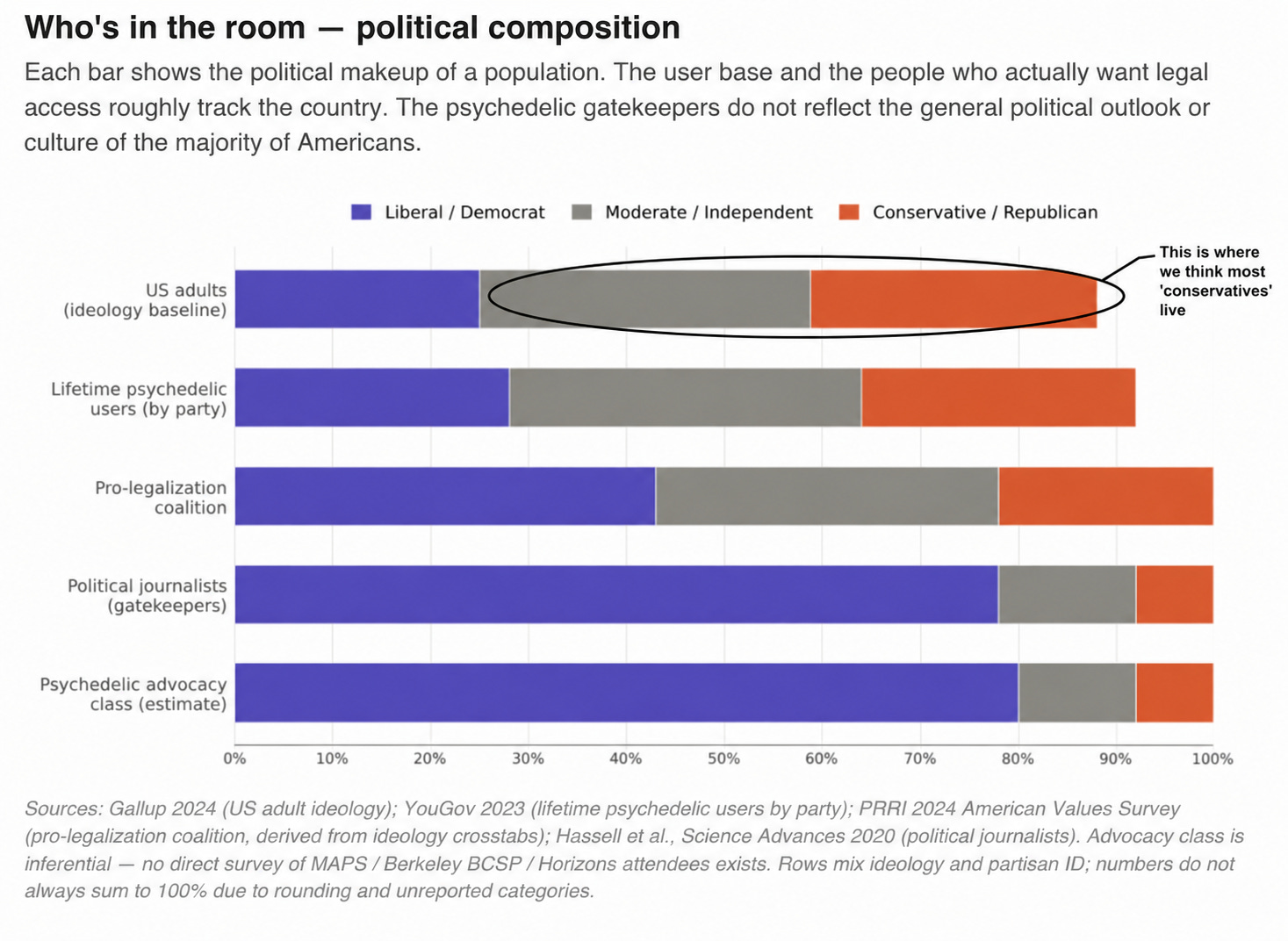
We are starting Sensible Psychedelics because the psychedelic conversation in America has been almost entirely captured by one side of the horseshoe—the reactionary left flank of it, specifically—and a lot of ordinary Americans have looked at the result and quietly decided this is not for them. Conferences feel like political liturgy. Trainings come with prerequisite reading lists on whiteness. Workshops on “decolonizing” your nervous system somehow get more airtime than workshops on the important work of integration or even more practically on how to re-embrace and strengthen your family once you return from your journey changed for the better.
This is a loss, and not only for the people being kept out. The psychedelic space needs the conservative temperament. It needs people who ask whether a new protocol has been validated before people start trying it. It needs people who think families are worth preserving and that veterans deserve every tool we can give them, even if it doesn’t turn them into pacifists. It needs people who are suspicious of utopian promises, and aren’t looking for gurus. It needs people who treat psychedelics with humility born from an appreciation of the complexity of the human spirit.
We are inviting those people in. We are not, to be clear, doing what the other side has been doing. We are not asking liberal voices to leave. We are not trying to shut down progressive perspectives or New Age perspectives or harm-reduction perspectives or anything else. The psychedelic space is big enough to hold all of it, and frankly it should, because the entire point of the work is to expand our understanding of ourselves and our relationship to everyone else. A movement that claims to be about consciousness expansion cannot, with a straight face, be in the business of narrowing the range of people allowed to participate.
We are near-absolutists on free speech for the same reason. Once you start deciding which thoughts are too dangerous to be spoken, you end up with a movement that has more in common with authoritarianism rather than with anything psychedelic. The whole experience the medicine offers is the experience of being honest with yourself about what is actually in your mind, including the parts you would rather not look at. You cannot build a culture around that kind of honesty while simultaneously enforcing a list of approved opinions.
So when we say conservative, we are not asking you to adopt a worldview. We are not recruiting you into anything. We are recognizing a temperament: free-thinking, heterodox, pluralist, skeptical of utopian promises from any direction, and genuinely tolerant of people who see the world differently. The only thing we are not tolerant of is intolerance. We abhor the insistence that there is one correct way to come into a psychedelic experience and one correct set of conclusions to come out of it. That is just another orthodoxy in tie-dye and feathers.
Welcome. Pull up a chair. We will save you a seat regardless of which way you vote.